
The Library is not a product catalog; it is an inventory + rules + verifiable outputs system.
Here, the same system expands through Configurations (Base Forms + Alphabet Forms), adapts via the Shell Ecosystem, and is anchored to metrics and evidence through Performance.
A partner technical pack for manufacturing and integration.
Start with Base Forms: OM’s 10 fundamental square/rectangle reference forms.
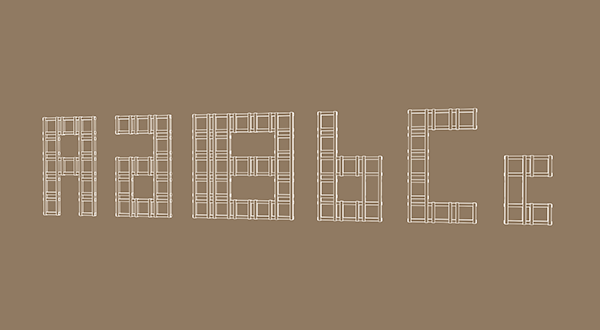
Then Alphabet Forms: A, B, C... I, L, T, Z… and grid-defined variants (L2×2, L3×2…).
Open Envelope/Cladding Ecosystem: the same structural logic supports multiple envelope and cladding systems.
Beyond materials, cladding pattern logic is configurable.
Target thermal, acoustic, and fire performance through envelope selection and layer combinations.
Track data, reports, and technical verification files in one place.
PDFs, technical drawings, CAD files, BOM sheets, and assembly documents.
A partner documentation pack—shared via access request.
In OmniMino, configurations are not a ready-made product catalog; they are a modular grammar that governs form, scale, and combination logic. This grammar is read along two branches: Base Forms—OmniMino’s reference set of 10 fundamental square/rectangle forms; and Alphabet Forms—letter families such as I, L, T, Z…, scaled through the Bay Grid into defined variants (L2×2, L3×2, L5×5…).
This defined structure enables OmniMino to generate a vast configuration space using a hyper-optimized set of four profile lengths (1k/2k/3k/5k)—making outcomes repeatable, comparable, and standardized. By constraining the system through explicit rules, the design workload shifts away from ad-hoc engineering recalculation and toward architectural composition. For that reason, Configurations does not merely list “module types”; it describes how the system grows through the systematization, clustering, and scale families of building components. Here, designing is not an abstract drawing exercise—it is a physical act of thinking with parts and possibilities: not form, but a rule set.
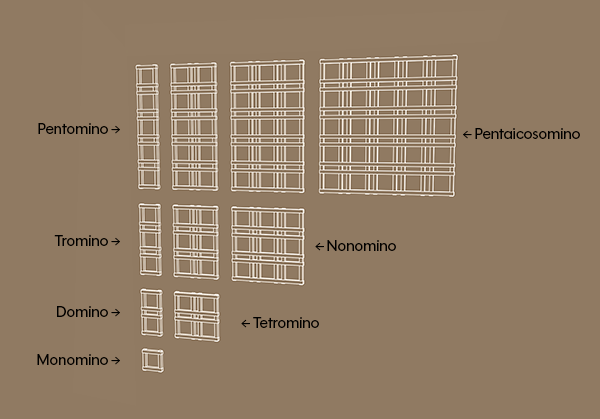
A limited part set—an unlimited composition space. Manufacturable from a constrained kit, readable through the Bay Grid, repeatable across scales.
The Shell Ecosystem treats OmniMino’s structural core as the durable support layer and the envelope/cladding as an open, replaceable layer—an ecosystem of compatible assemblies rather than a single “material choice.”
The same core can be fitted with different envelope solutions according to explicit performance targets (Thermal / Acoustic / Fire) and budget parameters, then serviced and replaced without compromising the structural logic. This is a layered, demountable approach: value and adaptability are maintained by keeping systems separable, recoverable, and reversible.
The Shell Ecosystem is not locked to an “ideal thickness.” Thickness becomes a controllable design variable that directly tunes performance and cost. Extremely thin skins (e.g., membranes), polycarbonate, thin sheet metal, and thick insulated sandwich panels can all be applied on the same structure. Thickness differences are resolved primarily through edge and corner trim components—no separate panel size set is required.
Hybrid Inlay™ is an OmniMino-specific integration technique that resolves this open envelope logic at the cell scale. The cladding/envelope element seats into the Bay geometry and can be used on both interior and exterior surfaces without screws, nails, or adhesives; it can be disassembled non-destructively, reused, or replaced.
Because the core and envelope are technically decoupled, the identity and performance of the space can be updated by changing only the relevant cladding/envelope layer; the structural core remains intact.
The envelope also carries a cladding pattern language—layout logic that can be configured alongside material selection. Verification files and evidence live in the Performance section.
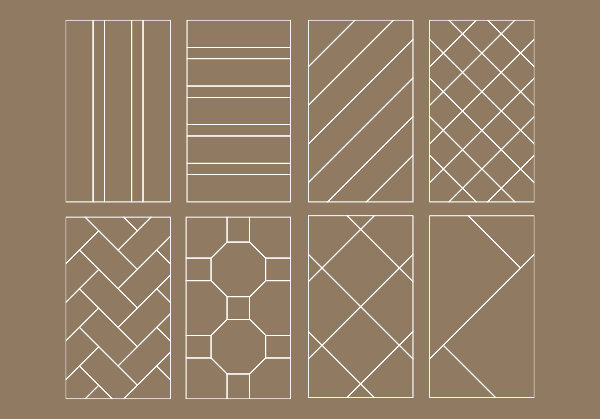
Same dimensions. Different envelopes. Thickness tunes cost and performance; corner adaptation is sufficient.
Technical Notes
In OmniMino, Performance is not a showcase of claims; it is a verification layer that connects envelope and layer decisions to measurable outcomes. We do not evaluate a single material in isolation—we evaluate assembly-level performance: envelope thicknesses and layered build-ups configured on the same structural core to meet Thermal / Acoustic / Fire targets.
Our method reads each performance topic through a three-part protocol:
As metrics are added to the Library, performance stops being “promised” and becomes a reusable technical asset that can be directly integrated into projects. The system therefore supports comparable, evidence-backed outcomes across different targets.
Not a claim—an evidence package.
Technical Notes: Data entry is in progress. Assembly-level performance simulations and supporting verification files will be listed here as they are added.
The Core and Resources contain technical packages reserved for platform partners for manufacturing, licensing, and integration workflows.
To continue, please request access.
The Core and Resources contain technical packages reserved for platform partners for manufacturing, licensing, and integration workflows.
To continue, please request access.