OmniMino is a living building system that can change.
Here’s what that means: it creates spaces by combining Tetris’s geometric intelligence, LEGO’s build & rebuild freedom, and the flexibility to change shells as if changing costumes. Depending on the conditions, it may wear a light shirt or a heavy coat.
Its assembly logic is simple enough that most applications require no special skill or equipment. As needs change, the structure can be disassembled without damage, expanded or reduced, raised or lowered, carried by hand, module by module, reassembled, and given a new identity with a new envelope.
OmniMino is therefore
a long-lived, dynamic spatial asset—one that does not turn its parts into scrap, but can keep them in a cycle of reuse.
It is not a single, fixed, factory-issued form, but an open-ended universe of spatial possibilities, with no limit to what it can be or become.
A system is reversible when it can be disassembled without damage, adapted to changing needs, and its parts reused. It is reconfigurable when countless spatial configurations, at different scales and for different functions, can be created time and again using the same limited set of parts.
Even more strikingly, countless OmniMino modules derive from just four timber profile sizes, much as countless sequences arise from DNA’s four-nucleotide alphabet.
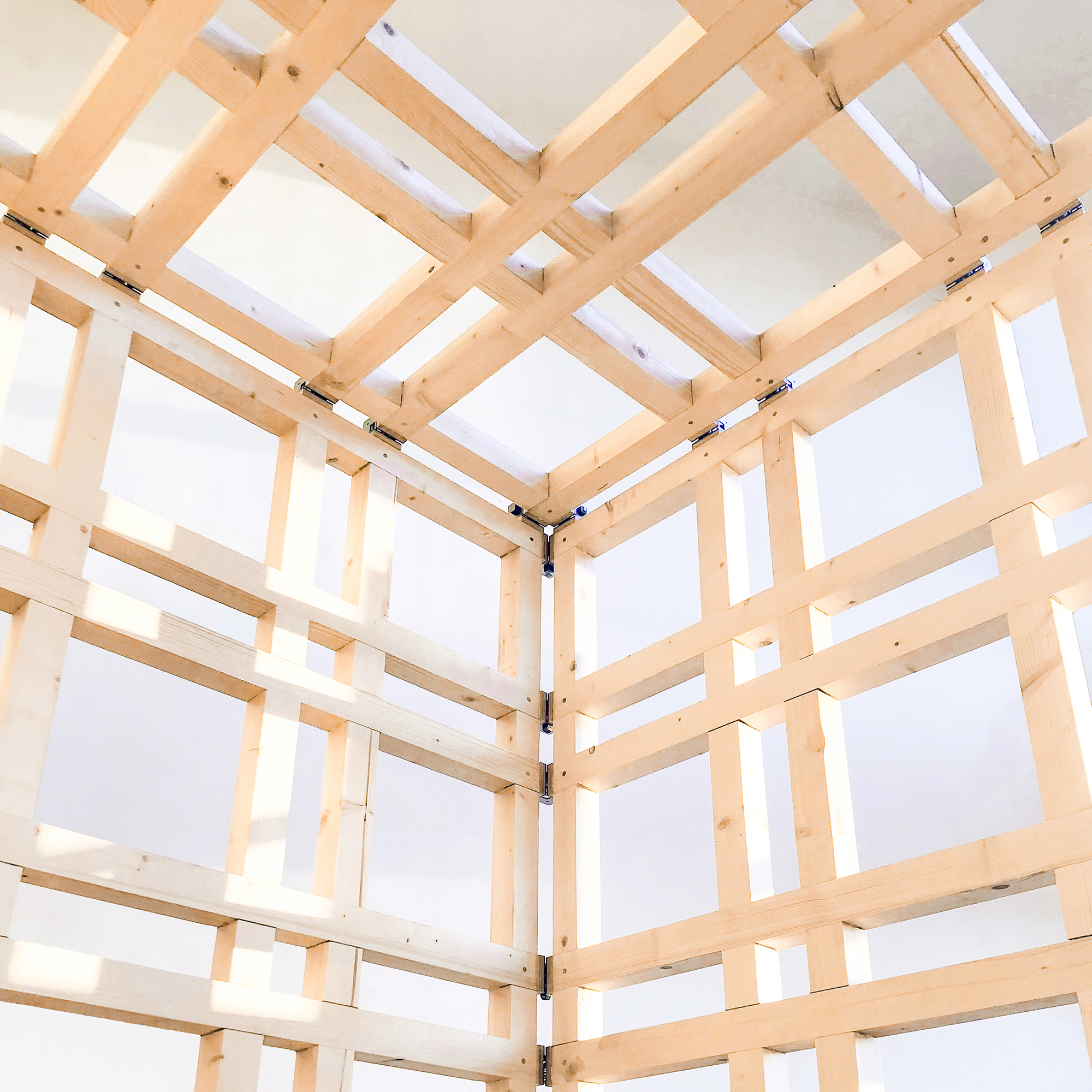
The lattice logic of Jigumi, an ancient Japanese building technique, forms the modules, while Komisen provides non-destructive, reversible locking through the Multi-Axial Active Metal Node™.

In this way, polyomino geometry takes physical form as a contemporary, three-dimensional structural system.

With a Polyomino-based coordination system, an unlimited range of modules and configurations can be derived from a limited kit of parts.

The Di-Plex timber lattice frame establishes a reconfigurable, load-bearing structural order and enables diverse topologies using the same components.

The Active-Node Interface standardizes joints through a square-pin lock, making the mate–lock–release cycle repeatable.
This synthesis integrates Reversible Building Design goals: Spatial Flexibility, Technical Flexibility, and Material Flexibility.

Not a single final form, but a set of possibilities responding to changing needs. OmniMino generates endless spatial configurations from the same kit-of-parts—expanding design freedom through an open shell ecosystem.
No demolition, no waste. Treating buildings as material banks, the entire system is designed to be disassembled and recovered while preserving value. The structure transforms from a sunk cost into a relocatable, dynamic asset.
Decoupled from logistics and site constraints. Hand-portable components typically eliminate the need for heavy machinery or cranes. With simple tools, OmniMino delivers installation freedom—even in the most challenging locations.


Tiny house, glamping/hospitality, garden studios, camellia interior layouts, podcast rooms. Not a room-in-a-box, but a living setup that expands or contracts with changing needs—using the same kit-of-parts.

Factory & warehouse offices, flexible partitions, screens, retail shelving systems. As operations shift, space shifts with it: the layout relocates, reconfigures, and keeps the workflow intact.

Expo stands, stage & set builds, pop-up spaces, campus/education, urban furniture & gazebos. High-impact setups go up fast; when the event ends, they pack down cleanly and move to the next context.

Disaster shelter, site offices, security points, storage/technical units, greenhouse/barn structures. Built for moments when speed matters—then removed without leaving a burden behind.

The structural core remains constant; the shell/cladding system is selected by performance and budget, and can be removed and replaced non-destructively. OmniMino is not tied to a single envelope type: from sandwich panels to glass/polycarbonate and timber, it integrates shells of different thicknesses seamlessly on the same structure.
Depending on the application, shell/cladding layers are integrated using Hybrid Inlay™ or OM‑Fix Rail™. Hybrid Inlay™ fits the layers into the frame without requiring screws, nails, or adhesives; OM‑Fix Ray™ enables exterior cladding panels to be secured to rails fixed to the substructure—without directly piercing the panels. Shell components can thus be disassembled without damage, reused, or replaced.
Using the same components, you can build and rearrange different spaces again and again as needs change—without specialized expertise or heavy equipment (including cranes).